Actions on the Sustainable Development Goals (SDG)
Overall, the teaching, research, and knowledge enhancement activities of the Department of Earth Sciences (DST) contribute to the pursuit of 11 out of 17 Sustainable Development Goals of the UN 2030 Agenda.
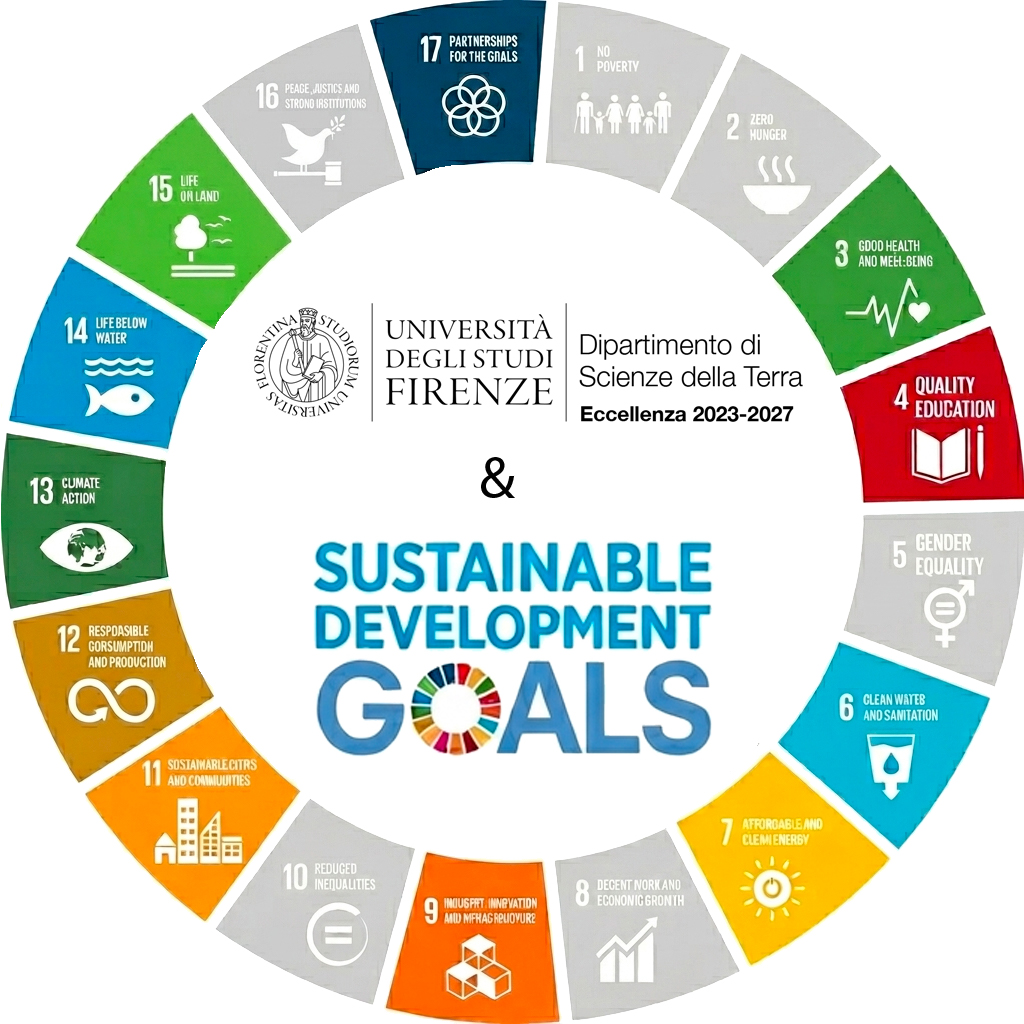
- SDG 3: Health and well-being through teaching courses aimed at protecting and safeguarding the environment;
- SDG 4: Quality of education with educational paths that promote the acquisition of knowledge and skills also related to the other Sustainable Development Goals listed here;
- SDG 6: Clean water and sanitation through teaching courses and studies aimed at the protection and administration of water resources, both surface water and groundwater, also in line with the Water Framework Directive (2000/60/EC);
- SDG 7: Availability of clean energy through teaching courses and studies of innovative solutions in the geothermal field;
- SDG 9: Innovation, industry and development, through teaching courses, studies aimed at the development of innovative solutions in the geotechnical and environmental fields and technology transfer initiatives, which include, among other things, the filing of patents (3 active patents, a significant number if compared to the size of the DST and its non-purely industrial or technological nature);
- SDG 11: Sustainable cities and communities through teaching courses and studies aimed at promoting the safety and sustainability of urban areas and communities;
- SDG 12: Responsible consumption and production through teaching courses and studies on sustainable consumption and production patterns;
- SDG 13: Combating climate change through teaching courses and studies aimed at developing mitigation measures and resilience strategies;
- SDG 14: Life below water through teaching courses and studies aimed at the conservation of marine ecosystems;
- SDG 15: Life on Earth through teaching courses and studies aimed at the conservation of terrestrial ecosystems;
- SDG 17: Partnership for the purposes through national and international scientific collaborations and stipulation of agreements on behalf of third parties with public administrations and private partners in line with the principle of partnership for the achievement of common objectives, making use of its scientific production also in terms of operational and industrial impacts, thus promoting innovation and growth of the territory.
The research activities show a solid consistency with objectives 3.9, 6.3, 7a, 11.3, 11.4, 11.5, 11.b, 12.2, 12.c, 13.1, 13.2, 13.3, 14.3, 14.a, 15.3, 15.4, 15.5, 15.a and with the environmental guidelines of the European Union. Many of the DST's lines of investigation are in fact based on environmental sustainability and the management of natural risks, through an integrated approach capable of relating high-level scientific research and concrete repercussions on the socio-economic level.
In addition, the DST, together with the Civil Protection Center of the University of Florence, plays the role of Competence Center (CdC) for the National Department of Civil Protection (DPC) in the monitoring and assessment of hydrogeological and volcanic risks. In this context, it provides the DPC with data, specialized services, consultancy and technical-scientific support, with particular attention to phenomena such as landslides, subsidence, avalanches and the surveillance of volcanic systems. These activities involve numerous researchers and technicians from the University of Florence, engaged in applied research in Earth Sciences and oriented towards land management and mitigation of natural risks.
As regards a more detailed description of the Sustainable Development Goals with regard to Teaching, Research and the Enhancement of Knowledge, reference ismade to the individual areas (the Syllabi of the various courses for the first point and the Research Registry for the other two).
Last update
15.04.2026